
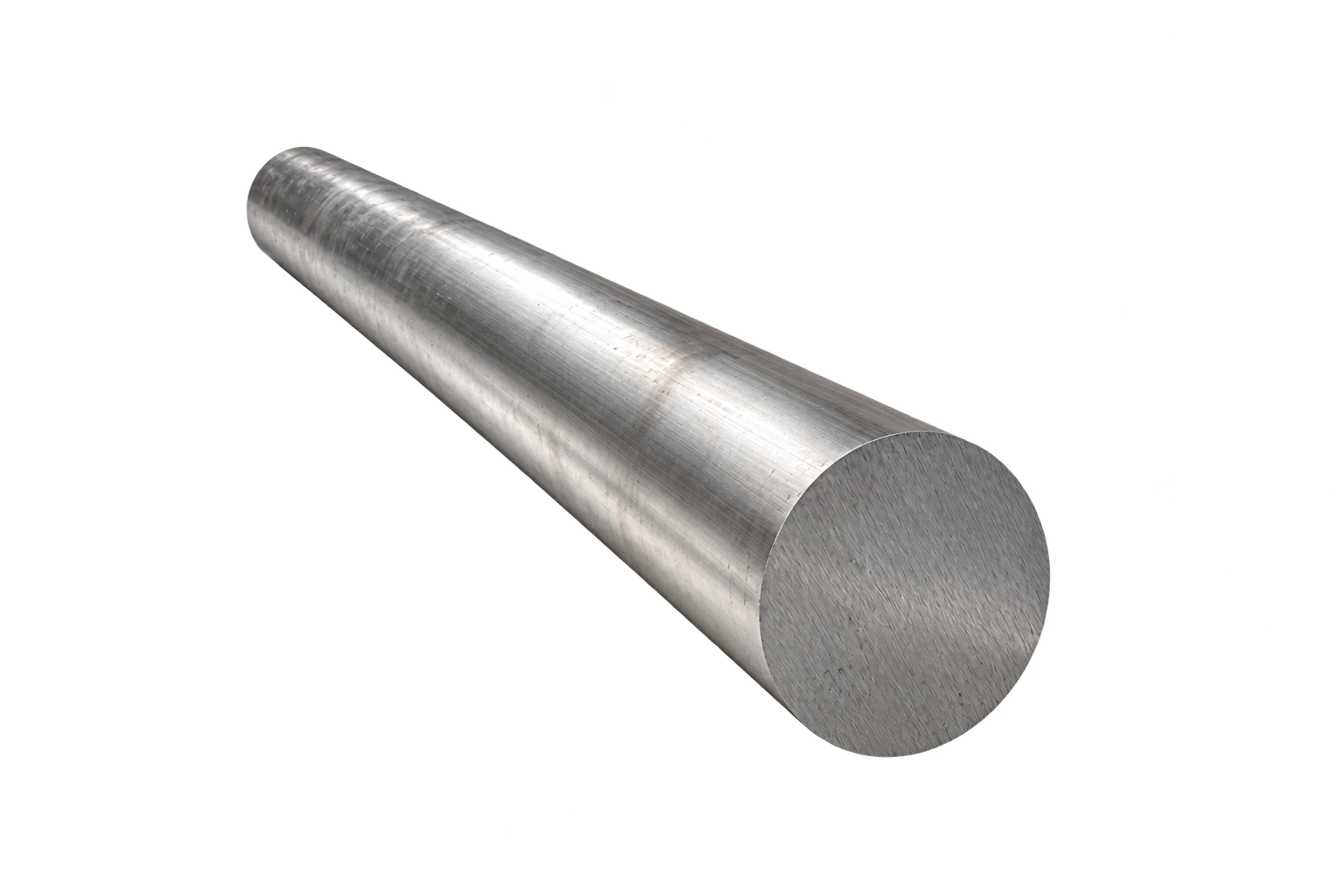
304/304L Stainless Steel Round Bar
304/304L stainless round bar, annealed, for general-purpose shafts, pins, fittings, food and chemical service. Nox stocks it in the diameters in the table below and cuts it to the length you need, −0/+1/8 in, with mill certs and heat/lot traceability. $180 order minimum, no minimum quantity.
Enter your size
Decimals or fractions, like 12.5 or 12 1/2. Cut to order up to 144.5 in long.
Mill certifications included with every option. Certification requirements
Factos prices your cut instantly in the cart.
Sizes
Specifications
| Grade | 304/304L |
|---|---|
| Condition | Annealed |
Cutting and lengths
We cut stainless round bar to any length, −0/+1/8 in; tighter tolerances are available on request. Bar is cut oversize (+1/8 in) so you can machine to finished size.
Mill certs and DFARS
Full mill certs with heat/lot traceability ship with every order and are saved in your portal. Nox is certified to ISO 9001:2015. DFARS melt is available for 304/304L in select diameters; choose it when you quote.
304/304L Annealed Stainless Round Bar properties
304/304L annealed round bar is the general-purpose austenitic stainless bar used for shafts, pins, fittings, food equipment, and chemical hardware. Chromium and nickel create its corrosion-resistant, ductile structure; the low-carbon 304L side of a dual certification improves welded-service resistance to sensitization.
Values labeled typical are orientation- and section-dependent references, not design allowables. Use the current governing specification and the mill certificate for acceptance.
| Property | Reference value | How to use it |
|---|---|---|
| Density | 0.289 lb/in³ (8.00 g/cm³) | Nominal value used by the NOX weight calculator |
| Structure | Austenitic in the annealed condition | Cold work can increase magnetic response |
| Heat-treatment response | Not hardenable by heat treatment | Strength can increase through cold work |
| Corrosion behavior | Good general atmospheric and process resistance | Chlorides can cause pitting or crevice corrosion |
| Machining behavior | Work-hardens readily | Use positive tools, steady feed, and no dwell |
When 304 is the right stainless
Choose 304 for broadly corrosive indoor, food, water, and industrial environments when chloride exposure is not severe. It provides excellent ductility, weldability, and availability at a lower alloy cost than 316. It is not automatically “marine grade”; salt, bleach, and stagnant chloride solutions can overwhelm its passive film.
304L limits carbon to reduce sensitization risk in welded sections. A dual-certified 304/304L bar can satisfy either designation only when the cert demonstrates compliance. If the drawing says 304L, make the purchase order and receiving check say 304L rather than assuming every 304 bar qualifies.
Machine without work-hardening the surface
Annealed 304 is ductile and tends to work-harden. Use rigid setups, sharp positive-rake tooling, adequate chip load, and a feed that keeps the cutting edge below the hardened skin. Dwelling or rubbing can turn the next pass into a much harder cut and shorten tool life quickly.
Plan chip control and coolant delivery; long, stringy chips can damage the finish and create a safety problem. If machining volume dominates and corrosion demands are modest, compare 416 or a machinability-enhanced 304 product—but do not trade away corrosion, weldability, or specification compliance without approval.
Order by grade, condition, and service standard
State 304 or 304L, annealed condition, round-bar diameter, cut length, finish or tolerance, and the governing specification. ASTM A276 covers common stainless bars and shapes; ASTM A479 applies to bars and shapes for boilers and other pressure vessels. The drawing decides which one belongs on the order.
Verify UNS designation, chemistry, condition, specification, heat number, and mechanical test results on the cert. Keep stainless isolated from carbon-steel grinding dust and handling contamination when surface corrosion performance matters.
Specifications and purchase callouts
The controlling drawing decides which specification applies. A similar alloy name or typical-property table does not demonstrate compliance.
- ASTM A276
- ASTM A479 for pressure-service bar where specified
- AMS 5639 / AMS 5647 where required
History of 304 / 304L
Modern stainless steel emerged from chromium-steel research in the early 1900s. Patents for chromium-nickel austenitic steels appeared in 1912, and the 18% chromium, 8% nickel composition became one of the foundational stainless recipes. That lineage developed into Type 304, now the most familiar and widely used austenitic stainless grade.
The low-carbon 304L variant answered the risk of chromium-carbide precipitation during welding. Modern mills often produce chemistry and properties that allow a heat to be dual certified as 304/304L, but dual certification must appear on the mill document—it should not be inferred from a product label. Annealed bar remains the flexible starting condition because it restores ductility after hot or cold working.
- 1912 Chromium-nickel stainless is patented. Early austenitic stainless patents establish the family behind later 18-8 and Type 304 grades.
- 20th century 304 becomes the general-purpose grade. Its fabrication and corrosion balance drives use across food, chemical, architectural, and industrial equipment.
- Today Dual-certified 304/304L is common. Bar is frequently supplied to satisfy both grade designations when the certed chemistry and properties qualify.
Primary references
What customers say
“I bought a little over a ton of metal from Nox and, even with the cost of freight, it was cheaper than our usual supplier. I can't get over that. Nobody's ever beaten them on price before.”
Patrick McGowan
One Off Parts







Frequently asked questions
What is 304/304L stainless round bar used for?
General purpose: shafts, pins, fittings, food and chemical service.
What condition is 304/304L round bar supplied in?
Annealed.
What diameters of 304/304L round bar do you stock?
The diameters in the table above, each cut to the length you need.
Is 304/304L available with DFARS melt?
Yes. DFARS melt is available for 304/304L in select diameters; choose it when you quote.
Can you cut stainless round bar to length?
Yes. We cut it to the length you enter, −0/+1/8 in; tighter tolerances are available on request.
Is there a minimum order?
$180 order minimum. No minimum quantity, so a single piece is fine.
Do you include mill certs?
Yes. Full mill certs with heat/lot traceability ship with every order and are saved in your portal.
When will it ship?
Your ship date is calculated in under 60 seconds with your instant quote, before you order.
What is the difference between 304 and 304L?
304L has a lower maximum carbon content, reducing sensitization risk during welding. Many heats are dual certified, but the mill certification must show that the material meets the requested grade and specification.
Is annealed 304 magnetic?
Annealed austenitic 304 is generally low in magnetic response, but cold work and local processing can make it measurably magnetic. A magnet test cannot replace alloy verification or a mill certificate.
Should I choose 304 or 316 round bar?
Choose 316 when chlorides, salt spray, marine exposure, or certain aggressive chemicals justify its molybdenum-enhanced pitting resistance. Choose 304 for less aggressive service when cost, availability, and general corrosion performance are the better balance.
 Reviewed by Danny Goldberg · Last updated