
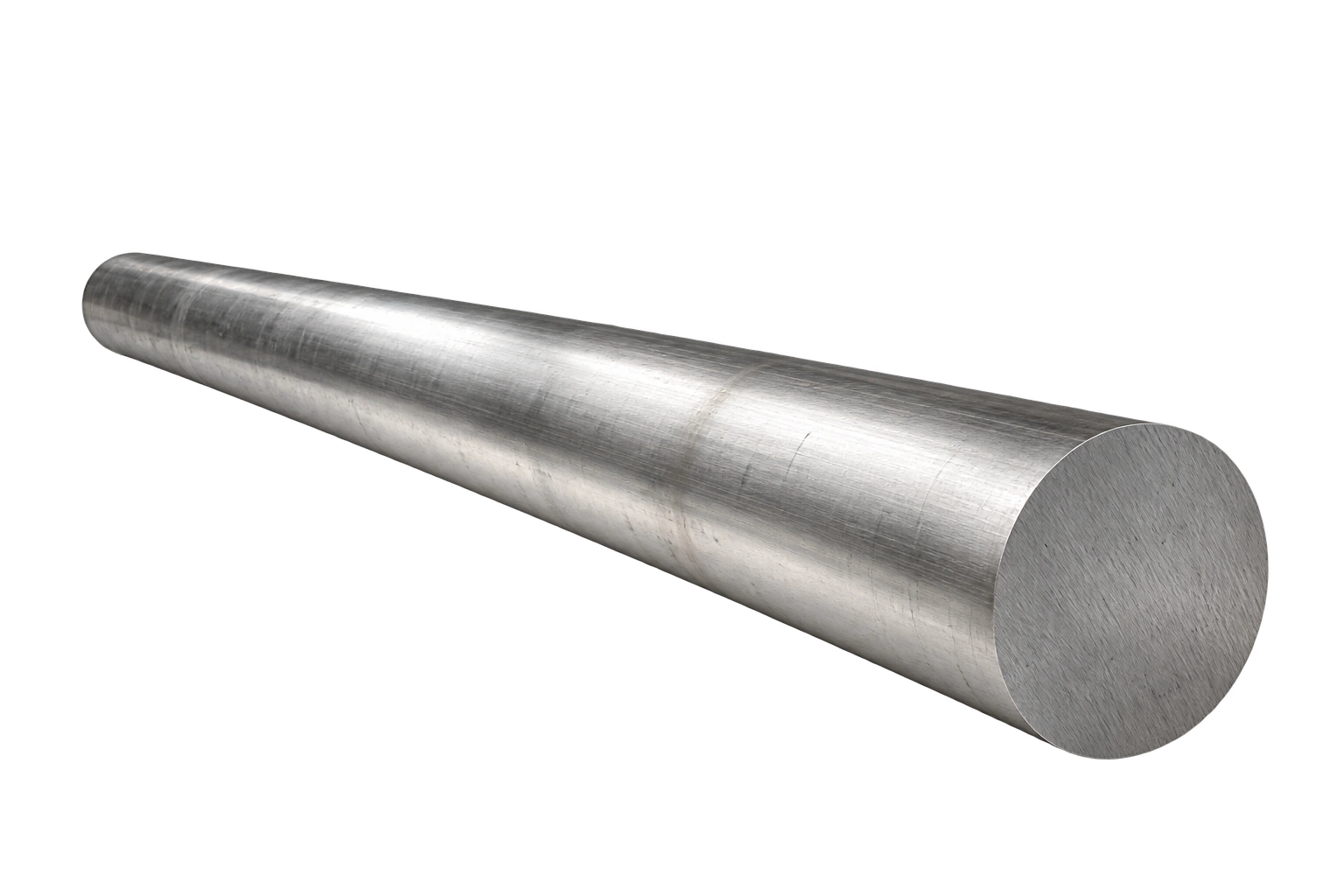
316/316L Stainless Steel Round Bar
316/316L stainless round bar, annealed, for chloride and marine service: salt water, brine and acid exposure. Nox stocks it in the diameters in the table below and cuts it to the length you need, −0/+1/8 in, with mill certs and heat/lot traceability. $180 order minimum, no minimum quantity.
Enter your size
Decimals or fractions, like 12.5 or 12 1/2. Cut to order up to 144.5 in long.
Mill certifications included with every option. Certification requirements
Factos prices your cut instantly in the cart.
Sizes
Specifications
| Grade | 316/316L |
|---|---|
| Condition | Annealed |
Cutting and lengths
We cut stainless round bar to any length, −0/+1/8 in; tighter tolerances are available on request. Bar is cut oversize (+1/8 in) so you can machine to finished size.
Mill certs and DFARS
Full mill certs with heat/lot traceability ship with every order and are saved in your portal. Nox is certified to ISO 9001:2015. DFARS melt is available for 316/316L in select diameters; choose it when you quote.
316/316L Annealed Stainless Round Bar properties
316/316L annealed round bar is an austenitic stainless with molybdenum added to improve resistance to chloride pitting and crevice corrosion compared with 304. It is a common choice for marine, pharmaceutical, food, chemical, and water-service parts, while 316L controls carbon for welded applications.
Values labeled typical are orientation- and section-dependent references, not design allowables. Use the current governing specification and the mill certificate for acceptance.
| Property | Reference value | How to use it |
|---|---|---|
| Density | 0.289 lb/in³ (8.00 g/cm³) | Nominal value used by the NOX weight calculator |
| Structure | Austenitic in the annealed condition | Cold work can change magnetic response |
| Heat-treatment response | Not hardenable by heat treatment | Strength increases through cold work instead |
| Key alloying distinction | Molybdenum-bearing | Improves localized-corrosion resistance versus 304 |
| Machining behavior | Work-hardens readily | Rigid cutting and continuous feed are important |
316 improves chloride resistance—it does not remove limits
Molybdenum makes 316 more resistant than 304 to pitting and crevice corrosion in many salt-bearing environments. That is why designers reach for it in marine hardware, process equipment, food and pharmaceutical systems, and water treatment. Temperature, chloride concentration, oxygen, deposits, crevices, and surface finish still control real performance.
For warm seawater, stagnant brine, or highly oxidizing chloride service, 316 may still be inadequate; duplex or higher-alloy stainless may be required. Material selection should be based on the actual environment, not on the shorthand “marine grade.”
Machining annealed 316 bar
316 is ductile, work-hardens quickly, and generally machines more slowly than 304. Use a rigid setup, sharp positive-rake tooling, firm feed, and enough depth of cut to stay below any hardened surface. Avoid dwell during drilling and turning, because rubbing makes the next engagement harder.
Control heat and chips with appropriate coolant and chip breakers. Long production work may justify a machinability-enhanced 316 grade, but the substitution must retain the corrosion, specification, and certification required by the drawing.
Define the grade and service requirement
Specify 316 or 316L, annealed condition, round-bar diameter, cut length, finish or tolerance, quantity, and ASTM A276 or A479 as required. If sanitary, pressure, defense, or origin rules apply, include them rather than relying on the alloy name to imply compliance.
Verify UNS designation, molybdenum and carbon chemistry, condition, specification, heat identity, and test results on the mill cert. Dual-certified 316/316L should be documented. Protect the finished part from iron contamination during cutting, grinding, and storage.
Specifications and purchase callouts
The controlling drawing decides which specification applies. A similar alloy name or typical-property table does not demonstrate compliance.
- ASTM A276
- ASTM A479 for pressure-service bar where specified
- AMS 5648 / AMS 5653 where required
History of 316 / 316L
The 316 family grew from the early chromium-nickel austenitic stainless steels developed around 1912. As stainless moved into chemical and coastal service, molybdenum additions became an important way to improve localized-corrosion resistance. Type 316 emerged as the widely used molybdenum-bearing partner to general-purpose 304.
The low-carbon 316L variant expanded use in welded vessels, piping, and sanitary equipment by reducing the risk of sensitization. Today mills often dual certify 316/316L when a heat satisfies both chemistry and mechanical requirements. The history is one of increasingly precise environment-based selection: 316 is not corrosion-proof, but it widens the usable range when 304 faces chloride attack.
- Early 1900s Austenitic stainless is established. Chromium-nickel metallurgy creates the family from which 304 and 316 develop.
- 20th century Molybdenum expands service. 316 becomes a standard response to pitting and crevice-corrosion concerns in chloride-bearing environments.
- Today 316/316L dual certification is common. Round bar serves marine, sanitary, pharmaceutical, chemical, and water-system machining.
Primary references
What customers say
“We needed a block as soon as we could get it. We put the order in Friday morning, I picked it up Saturday, and when the guys came in Monday they could get going right away. That's the customer service side of it.”
Chris Michayluk
President, Complete Prototype Services







Frequently asked questions
What is 316/316L stainless round bar used for?
Chloride and marine service: salt water, brine, acid exposure.
What condition is 316/316L round bar supplied in?
Annealed.
What diameters of 316/316L round bar do you stock?
The diameters in the table above, each cut to the length you need.
Is 316/316L available with DFARS melt?
Yes. DFARS melt is available for 316/316L in select diameters; choose it when you quote.
Can you cut stainless round bar to length?
Yes. We cut it to the length you enter, −0/+1/8 in; tighter tolerances are available on request.
Is there a minimum order?
$180 order minimum. No minimum quantity, so a single piece is fine.
Do you include mill certs?
Yes. Full mill certs with heat/lot traceability ship with every order and are saved in your portal.
When will it ship?
Your ship date is calculated in under 60 seconds with your instant quote, before you order.
Why is 316 more corrosion resistant than 304?
316 includes molybdenum, which improves resistance to chloride pitting and crevice corrosion in many environments. Performance still depends on concentration, temperature, deposits, crevices, stress, and surface condition, so it is not universally corrosion-proof.
What is the difference between 316 and 316L?
316L has lower maximum carbon to reduce sensitization risk during welding. A heat may be dual certified as 316/316L when it satisfies both sets of requirements, but that status must be confirmed on the mill certification.
Is 316 round bar difficult to machine?
It is more demanding than free-machining stainless because it is ductile and work-hardens rapidly. Rigid workholding, sharp tools, positive geometry, continuous feed, effective chip control, and avoiding dwell produce much better results.
 Reviewed by Danny Goldberg · Last updated